Southampton Town Quay
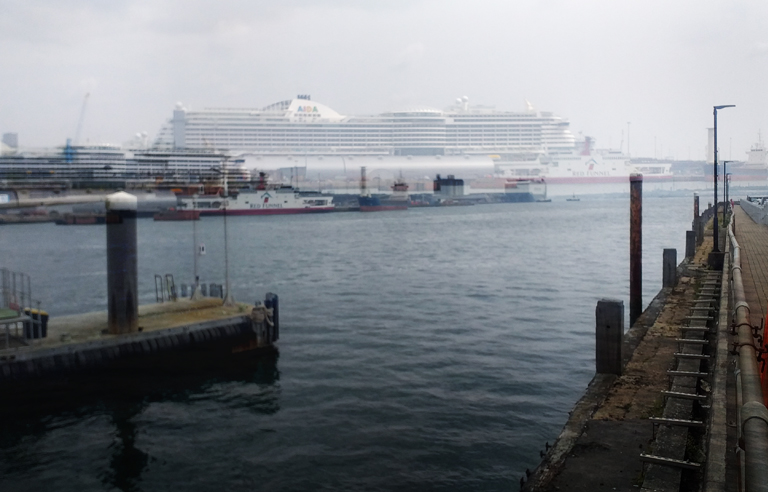
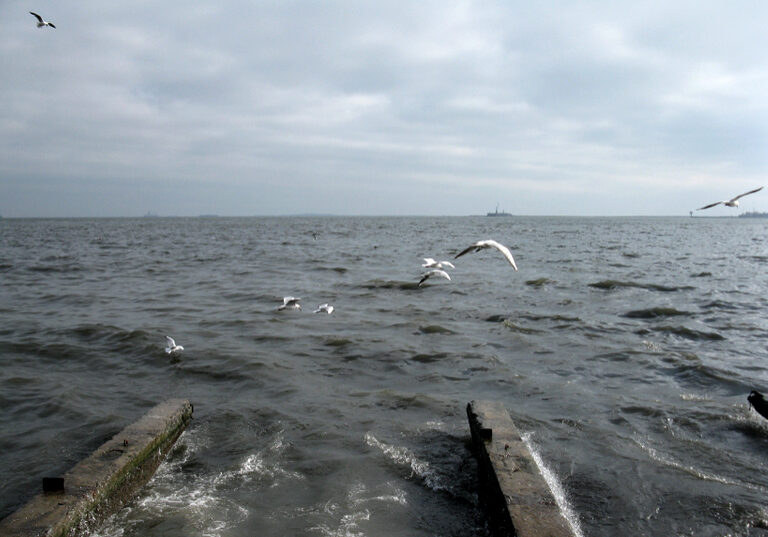
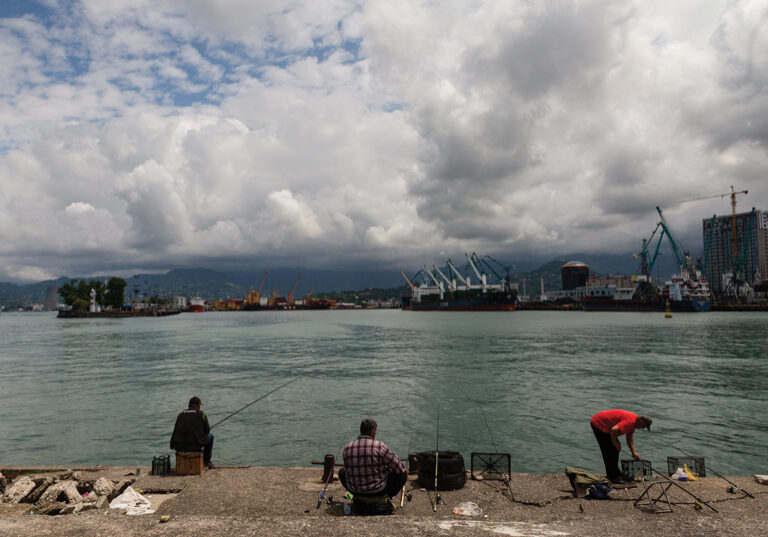
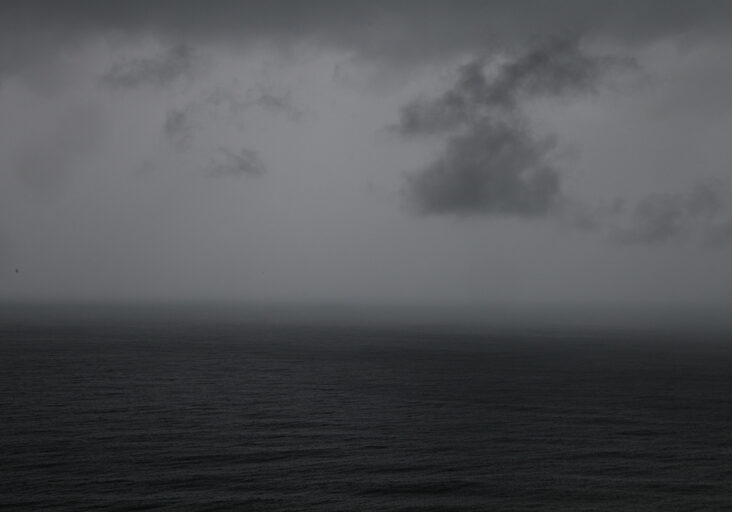
Image: Southampton water, from town quay, looking toward the Ocean Cruise Terminal.
Southampton water is a tidal estuary, with the port city of Southampton at the most northernly point, where the rivers Test and Ichen meet. Once the main point of departure for ocean liners, more recently it has been the home port for large cruise ships.
I first came here, way back in the last century, to photograph a Trinity House pilot guiding an oil tanker into the Fawley Terminal from the shipping lanes of the Solent. I was then here for some years, awarded a Fellowship in Photography at Southampton University, working with Leo Stable as he established the John Hansard Gallery.
On this particular day, the Mayflower park is blocked off, as marquees are being erected for a marine festival, while queues of cars and lorries wait alongside to board the ferry to the Isle of Wight. There are a few Spanish tourists wandering beneath the medieval town walls nearby, but the town quay itself is deserted. The only other people are in Starbucks; here you can find a few plaques in memory of the D-Day landings, and the millions of soldiers who left from here for the invasion of Europe in 1944-45.
It’s a cold and overcast morning. The light is as flat as the water itself. I make a few double-exposures.
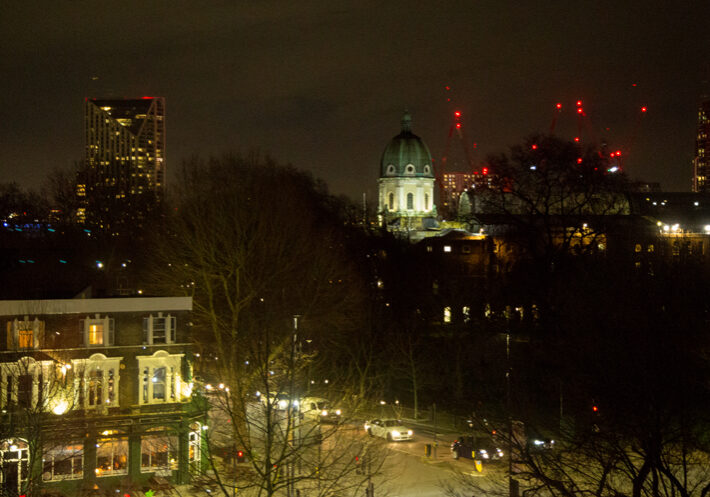
About a mile from the town quay stands the old Admiralty building, at the entrance to the cruise liner terminals. On the corner of this building is a commemorative plaque dedicated to ‘The Old Contemptibles 1914’. It was dedicated in 1950, and was originally placed on the gate entrance to the Eastern Dock, which was later demolished.
In the First World War, Southampton was designated as Military Embarkation Port No. 1. The railway took troops straight to the town quay; the trains were not allowed to stop anywhere else and went to the dockside sheds alongside the berth, where troopships were waiting.
Military planners split each working hour into five 12-minute segments, with the aim of getting one train successfully unloaded and moved on in each segment. In the early months of the war, at the peak of mobilization, up to eight trains were brought in each hour, resulting in some 90 troop trains per week arriving and departing. They say that only one train ran late during the whole first period of mobilisation. The trains were not allowed to stop anywhere and went straight to the dockside sheds alongside the berth, at which the troopships were waiting.
Southampton Common had large army rest camps and sites at Salisbury Plain and at Winchester were also used as assembly points. Most troops arrived and left here in less than 24 hours. By the end of the war, more than 7 million men had passed through the port, along with 179,069 vehicles, 859,830 horses, and 15,266 guns.
Here in Southampton, in January 1919, 20,000 soldiers went on strike; when units were ordered back to France, they refused and took over the docks, complaining about the slow pace of promised demobilisation. This was one of several similar protests at this time across the country. The Commander in Chief of the Home Forces sent General Trenchard to the port to restore some semblance of military authority.
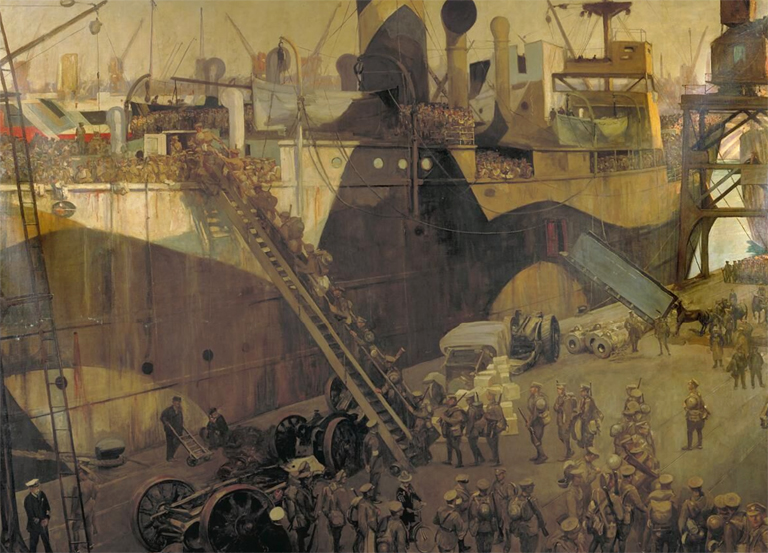
Troops Embarking at Southampton for the Western Front, 1917, John Lavery, an Irish painter appointed as official war artist, Imperial War museum collection, Art.IWM ART 2616.
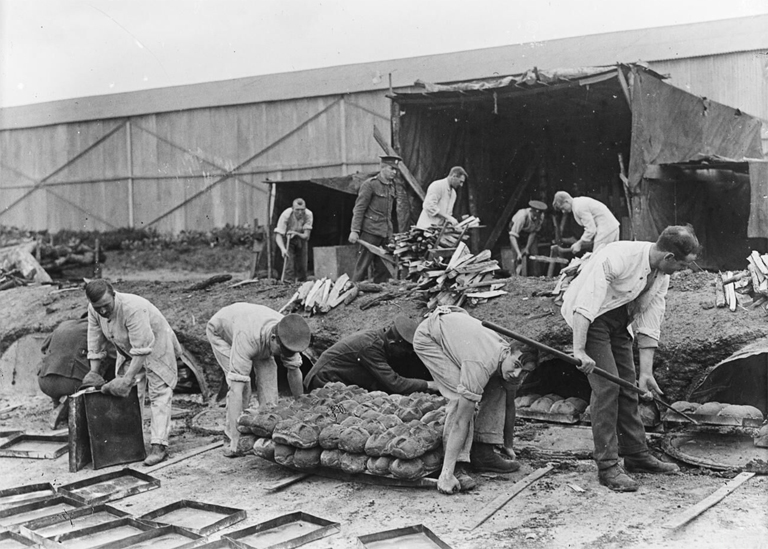
A baker in a field bakery is drawing bread from oven and assistants are carrying the baked bread away to store. Avington Camp, near Winchester, September 1917. Imperial War Museum collection Q 30104.
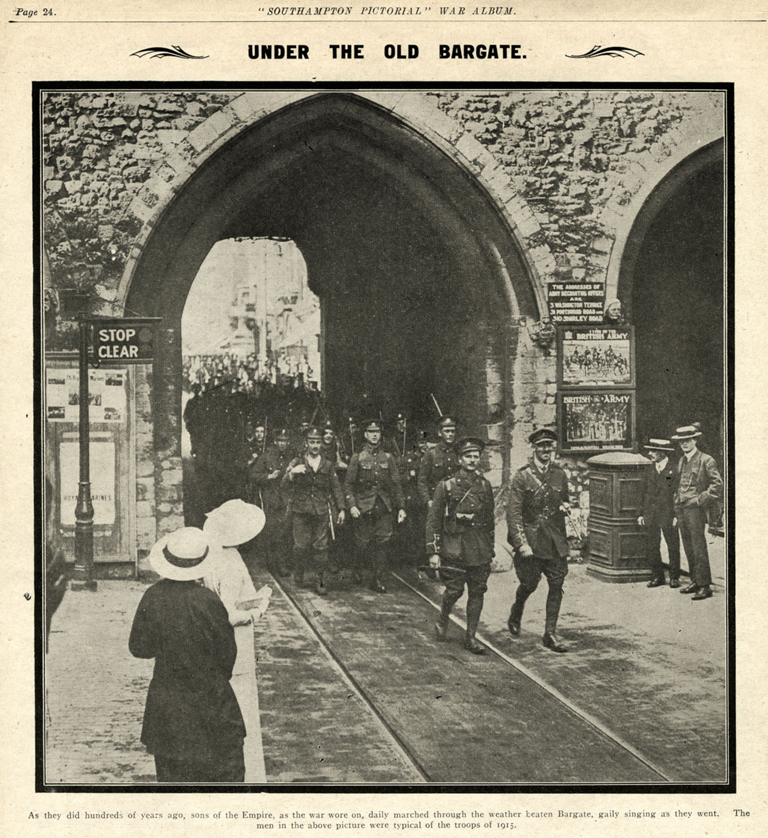
“As they did hundreds of years ago, sons of the Empire, as the war wore on, daily marched through the weather beaten Bargate, gaily singing as they went. The men in the above picture were typical of the troops of 1915.” Southampton Pictorial War Album, Southampton Archives.
In 1915, G.T. Veasey joins the Oxfordshire and Buckinghamshire Light Infantry as a Private and undertakes months of training at Salisbury Plain. In September, his battalion take a train to Southampton docks where they ‘hung about all day on the dock and embarked a night’ on a cargo boat. ‘It was a beautiful night and I lay on the deck watching the stars sway with the gentle roll of the boat, and wondered what would come next.’ They arrive at Le Havre, are taken to Amiens and then onto Marseilles to be shipped to Salonika. During the journey ‘the food was disgracefully short’ and he describes the journey as being shuffled about like a deck of cards. On arrival, his impressions are poor: ‘Feeling miserable and cold I looked out over the desolate looking country and thought, this is the old Thessalonika of the New Testament, no wonder St. Paul wrote “Come over to Macedonia and help us”. Never again would I grumble about England.’
A package arrived from his sister. It contains a now putrid pork pie. They sleep fourteen to a tent, the only way to keep warm. Lice are rampant in the camp. Despite doses of quinine – ‘horrible stuff” – he comes down with malaria, as do most of his compatriots. Their camp is called Summerhill – he prefers to call it Summer Hell. On Christmas Day, they have ‘the usual stew for dinner, two pints of beer, a football match and a singsong’. He joins the orchestra, as a drummer, as part of the 26th Division Theatre Company, who plan to stage ‘Robinson Crusoe’ for Christmas 1917. He writes: ‘The orchestra was getting into shape under Corporal Jack, a professional conductor and a wonderful violin player. The scenes were painted by men who were artists of no small repute. Our female impersonators were men of slight build and some with very effeminate ways. We all got interested the first time they put on their lovely ‘underwear’. It was really funny.’ Less that year later he is transferred from Salonika to the Army of the Black Sea, en route they are old, for duties in South Russia, where he will be part of the orchestra performing 'Babes in the Wood’ in Batoum and Tiflis, ‘a four act show full of songs and dances’.
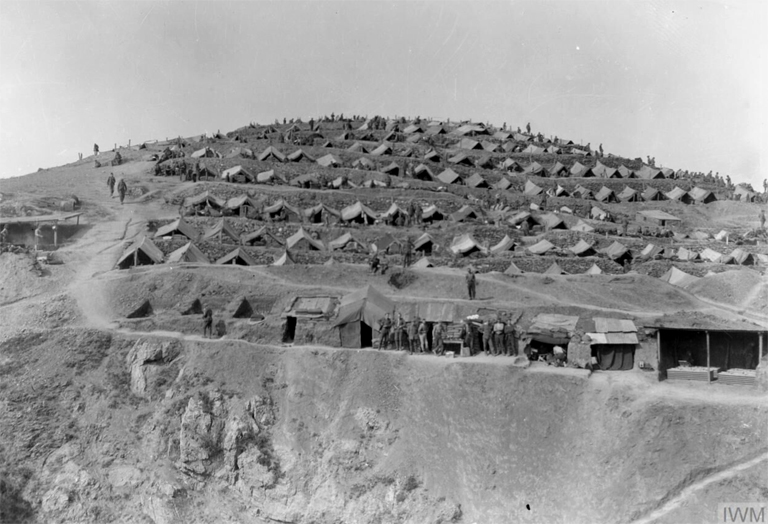
Summer Hill camp, north of Salonika, some 30 miles from the front lines. Photograph by Ariel Varges, 1916. IWM Q31865.